Provenance
Provenance is the running record of what an automated model did: every stage it ran, every check it passed, and how each number traces back to source. It is the audit surface that ships with the models we build, and that your team operates and owns.
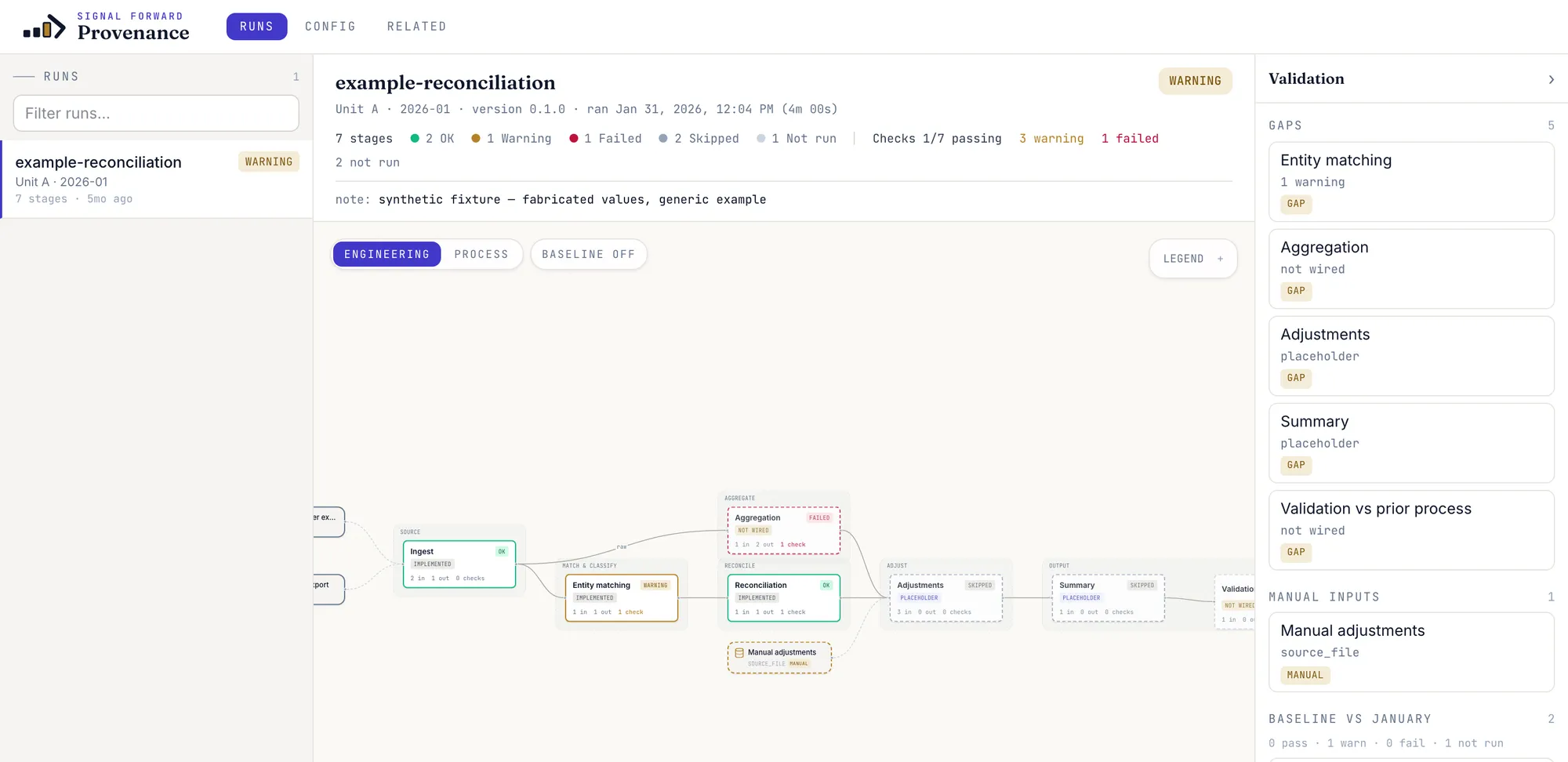
A run, opened. The header states what ran and what passed. The canvas maps every stage and dataset. The rail is honest about gaps, manual inputs, and what has not been wired yet. All figures are fabricated demo data.
The objection that stalls every AI deal is trust
What blocks automation in healthcare is rarely the model. It is that a CFO cannot underwrite, a controller cannot reconcile, and a committee cannot clear a number nobody can trace. Provenance is the rebuttal: the buyer opens the run and verifies the model themselves.
Every stage
The lineage canvas maps the whole pipeline: each stage, the datasets in and out, and an honest status for every step, including the ones still manual or not yet wired. Nothing is hidden behind a green checkmark.
Every check
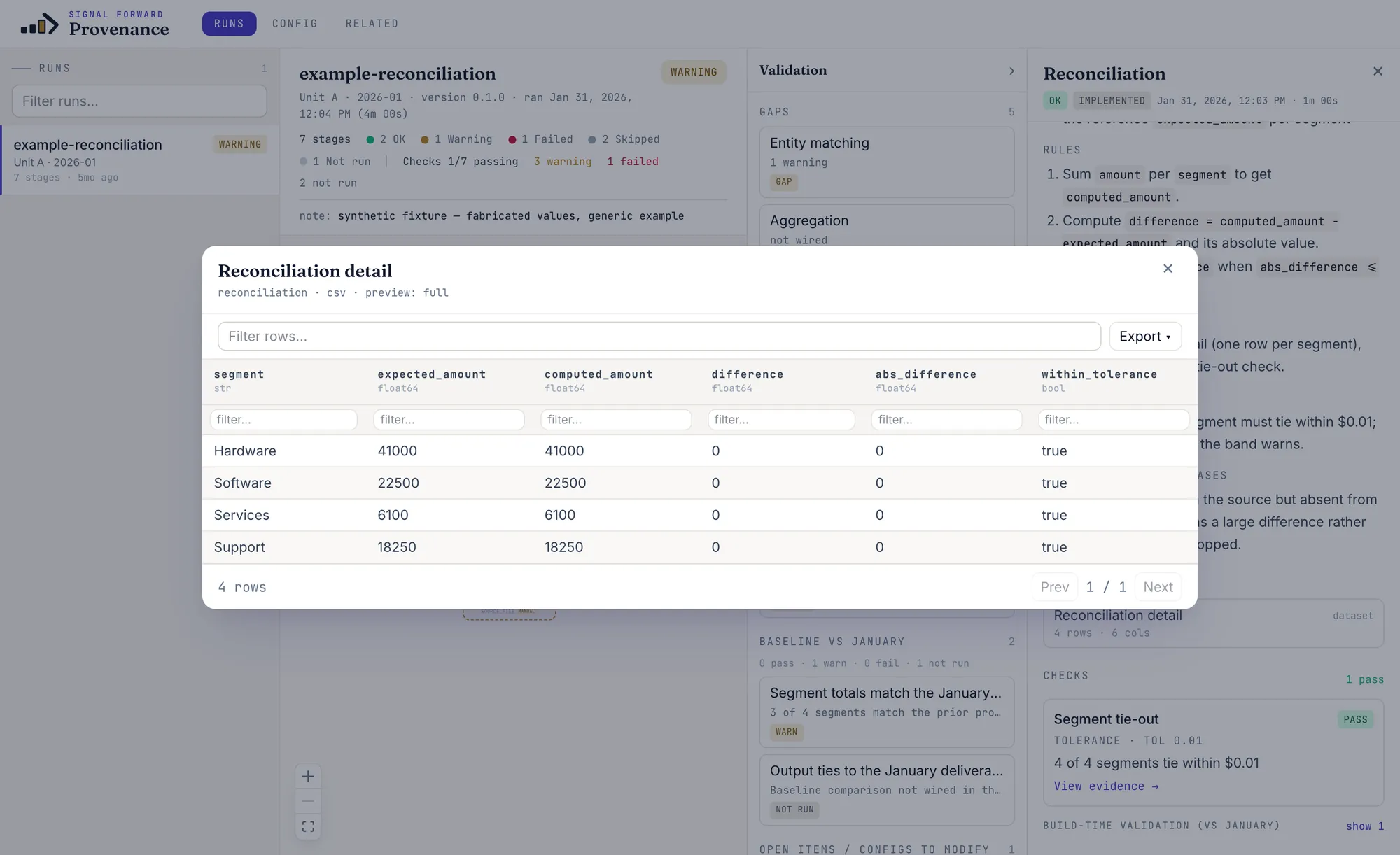
Tie-outs, tolerances, and coverage checks run with the pipeline and publish their evidence. When a segment ties within a cent, you can open the rows that prove it. When one does not, the run says so.
Every rule, in plain language
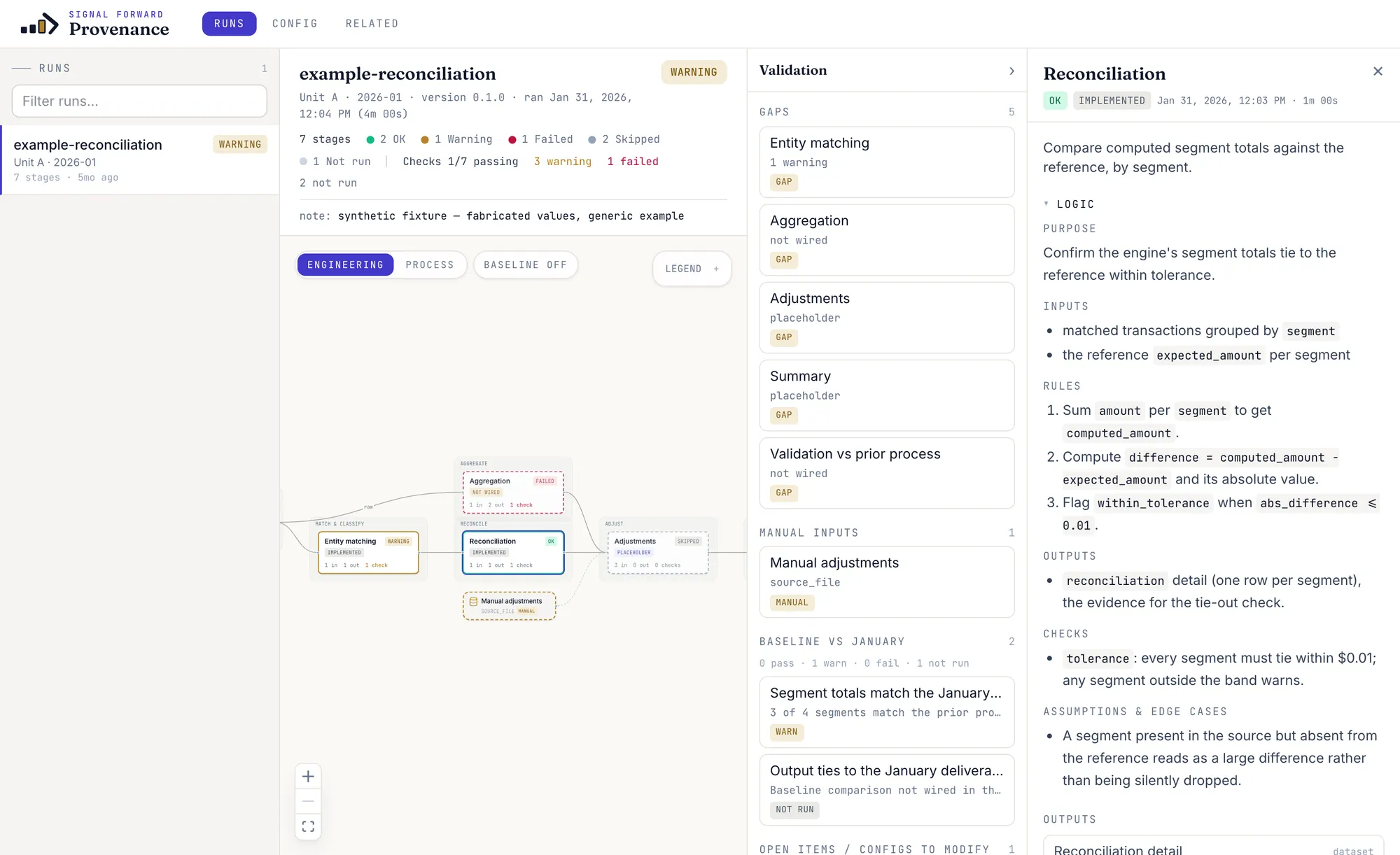
Each stage carries its logic in words a reviewer can read: purpose, inputs, rules, outputs, and edge cases. The documentation lives with the run, not in a binder that drifted two versions ago.
The logic reads like a memo, not a stack trace
Click any stage and Provenance explains it: what it is for, what it consumes, the rules it applies, and the edge cases it guards. The reconciliation stage shown here states its tolerance in dollars and lists the assumption a reviewer would ask about first.
That page is what an AI-governance committee, an auditor, or a skeptical controller actually needs. Not a promise of explainability. The explanation itself, attached to the run that used it.
Every dollar traces back to the system of record
A passing check is a claim; the evidence is the proof. Provenance keeps the two together. The tie-out shown here resolves to the exact rows behind it, filterable and exportable, so "the totals match" is something your team verifies rather than takes on faith.
For a finance owner, that is the property that makes an automated close trustworthy. For counsel, the same record is an audit trail built to hold up under scrutiny.
One surface, three buyers
Finance and the close
Watch the close run, and trace every dollar back to the system of record. The controller inspects each tie-out instead of trusting a spreadsheet nobody remembers building.
Operations and value-based care
See how every risk and opportunity number was produced, not just the score. The logic is documented, versioned, and open to the people the number affects.
Governance and research
An audit surface your AI-governance committee can clear: auditability and human-in-the-loop made concrete, running inside your environment with no PHI leaving the network.
Provenance completes our working arc. Validate and Transfer happen in the open: your team sees the model run, confirms each check, and takes handoff of a model it can keep auditing long after the engagement ends. A model you own, not a dependency.
Open the box yourself
The working demo runs on synthetic data, and it is more convincing than any page about it. Tell us about the number your organization has to trust, and we will walk you through a run in an intro call.